Dirk meyer‘s fire - gilding studio

A concise historie of fire - gilding
Dirk Meyer‘s
FIRE - GILDING STUDIO
registered conservator in
gold and silver smithery
Phone:
00498383 - 922783
Mobile:
00491577-3548950
E - mail:
dirkmeyer (at) fire-gilding.com
Postal address:
Atelier für Feuervergoldung
Dirk Meyer
Neppen 1
D - 88167 Maierhöfen
Germany

copyright by dirk meyer // webdesign phil zinser
The beginnings of fire-gilding (mercury-gilding) are remaining largely in the dark. This especially concerns the time when it was introduced in the western world.
In China, mercury-gilding was first used during the Zhou dynasty (3rd century B.C.), primarily for the decoration of belt buckles.
Between the 5th and the 10th century A.D., the Chinese fire-gilded, i.e. coated with pure gold, a huge amount of whole buddhist bronze sculptures.
In Western Europe, fire-gilding first appeared among the Celts who used it for mint counterfeiting and for jewellery. In the mediterranean area, the technology was first present in
the 1st century B.C., being thoroughly described by Vitruvius and Pliny. In the territory of Germania, fire-gilding was found till the 3rd century A.D. among Roman import goods. But only in the age of the Anglo-Saxons and the Merovingians considerable amounts of gilded jewellery and other objects appear, such as helmets and shield fittings.
Fire-gilding remained the predominating gilding technology throughout the whole European Middle Ages and even subsequently.
From the 15th to the mid- 17th century, fire-gilding often was part of decorating high-grade steel armour.
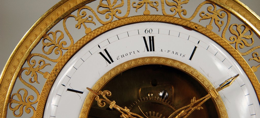
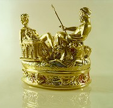
A sophisticated art of fire-gilding had developed near the end of the 17th century in France. There, artistic metal objects ennobled by mercury-gilding were called ormoulu. Among products of ormoulu were furniture fittings, door-handles, jewellery boxes, vases, light-fittings of any kind, candle-holders and sconces, clocks, and the elaborate andirons known as „chenets“. If the ormoulu objects really were first class, then mate surfaces got elaborately chased in order to increase contrast against the glossy gilded parts.
The shaping of ormoulu objects is connected with France primarily because since the mid- 17th century elaborate methods of production were developed. The making of ormoulu was considered a handicraft of specialists.
Since the mid- 19th century, mercury-gilding was slowly replaced by galvanic gilding. Still, many objects were cast in the traditional ways, but the colour of the coating and its somewhat poor appearance allows distinguishing these electrolytically gilded brass and bronze fabrications from real ormoulu.